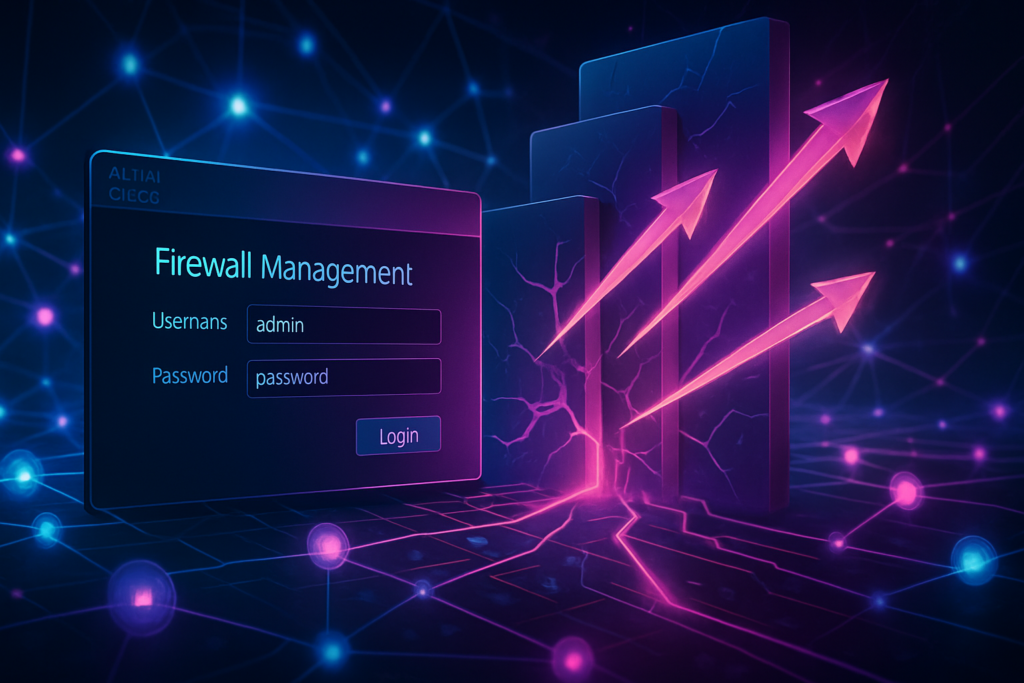
A new Cisco FMC zero-day is being actively exploited in production environments. Cisco confirmed detection of the exploit in the first days of July 2026. The attack vector involves static credentials that could expose sensitive data and grant privileged access to managed systems.
What We Know About the Incident
The Vulnerability and Its Impact
The Cisco Firepower Management Center (FMC) is a centralized management platform that controls security devices deployed across enterprise environments. Compromising the FMC means gaining visibility and control over entire network segments.
In this case, static credentials hardcoded into the system represent the critical entry point. An attacker who exploits them can move laterally through the network, alter configurations, create unauthorized accounts, or exfiltrate sensitive data.
Cisco has confirmed active exploitation, but at the time of publication has not attributed the activity to any specific threat group. The actor behind the attacks remains publicly unidentified.
The Technical Detail: Static Credentials as a Systemic Risk
Static credentials do not change over time and require no user interaction to be leveraged — which makes them powerful weapons for anyone who knows the default values.
In environments where the FMC is exposed on non-segregated networks, the risk escalates dramatically. As a result, every device managed by the platform must be treated as potentially compromised.
A Well-Established Pattern: Attacks on Cisco Keep Coming
The March 2026 Precedent
This incident is far from isolated. Back in March 2026, the Interlock ransomware group had already exploited an FMC vulnerability — tracked as CVE-2026-20131 — that allowed unauthenticated remote code execution with root privileges.
Both Amazon Threat Intelligence and Cisco confirmed active exploitation before public disclosure. This highlights a troubling trend: exploitation consistently outpaces available patches.
Other Significant Incidents in the Sector
In December 2025, Cisco Secure Email Gateway was targeted via CVE-2025-20393, an incident that researchers and vendors linked to a Chinese APT cluster tracked as UNC-9686. That case demonstrated that Cisco infrastructure is in the crosshairs not only of cybercriminals, but also of state-sponsored actors.
By mid-2025, actively exploited vulnerabilities in ASA/FTD devices — including CVE-2025-20333 and CVE-2025-20362 — were attributed by Palo Alto Networks to a sophisticated nation-state actor. Yet the common denominator remains unchanged: perimeter appliances are high-value targets.
Why Attackers Go After the Management Plane
The logic is purely strategic. Compromising a single endpoint is resource-intensive. Compromising a management platform, on the other hand, means controlling dozens or even hundreds of devices in a single move.
This approach is equally efficient for ransomware operators and APT groups. The FMC, ASA, ISE, and Cisco email gateways are all prime examples of this high-yield target category.
How to Respond: A Practical Guide for CISOs and Security Managers
Immediate Actions to Take
When a Cisco FMC zero-day is actively exploited, priorities shift entirely. This is not a vulnerability to queue in the standard backlog — it demands an immediate response.
Recommended actions include:
- Apply emergency patches as soon as they are released by the vendor
- Audit exposed assets: any FMC accessible from untrusted networks is at risk
- Restrict access to management interfaces via VPN or dedicated out-of-band networks
- Review logs and configurations for unauthorized accounts or anomalous changes
- Monitor the CISA KEV catalog for official confirmation of active exploitation
Compensating Controls and Defensive Posture
When immediate patching is not feasible, compensating controls become essential. Network segmentation, in particular, dramatically reduces the exposed attack surface.
Strong authentication for administrative access must also be enforced. The principle of least privilege should apply to appliance management accounts without exception.
Organizations should additionally revisit their backup and recovery procedures for the management plane. A compromised FMC must be replaceable quickly with a clean, validated configuration.
Finally, following any public disclosure of this nature, a compromise assessment is strongly recommended. Several recent Cisco incidents have revealed that exploitation had been ongoing for weeks before discovery.
Conclusion
The Cisco FMC zero-day confirmed in July 2026 fits squarely into a clear and well-documented pattern. Ransomware operators, APT groups, and unidentified threat actors alike continue to target security management platforms — and the reason is straightforward: the return on investment is unmatched.
For organizations, a reactive posture is no longer sufficient. The response must become structural: rapid patching, full asset visibility, restricted access, and genuine incident response readiness.
Sources:
- The Hacker News – Cisco FMC Zero-Day Actively Exploited
- Dev.to – Cisco FMC CVE-2026-20316: Active Exploitation Chain
Source: Original article
Incidents like the Cisco FMC zero-day make it clear just how critical timely threat intelligence sharing is among organizations operating in the same sector. IsacChain addresses this need by offering a secure, blockchain-verified sharing platform that enables organizations to receive indicators of compromise in real time and automate NIS2 compliance workflows. Blockchain verification guarantees the integrity and provenance of every shared data point, reducing the risk of manipulated or unreliable information reaching your security teams. Discover how IsacChain can help your organization at www.isacchain.com