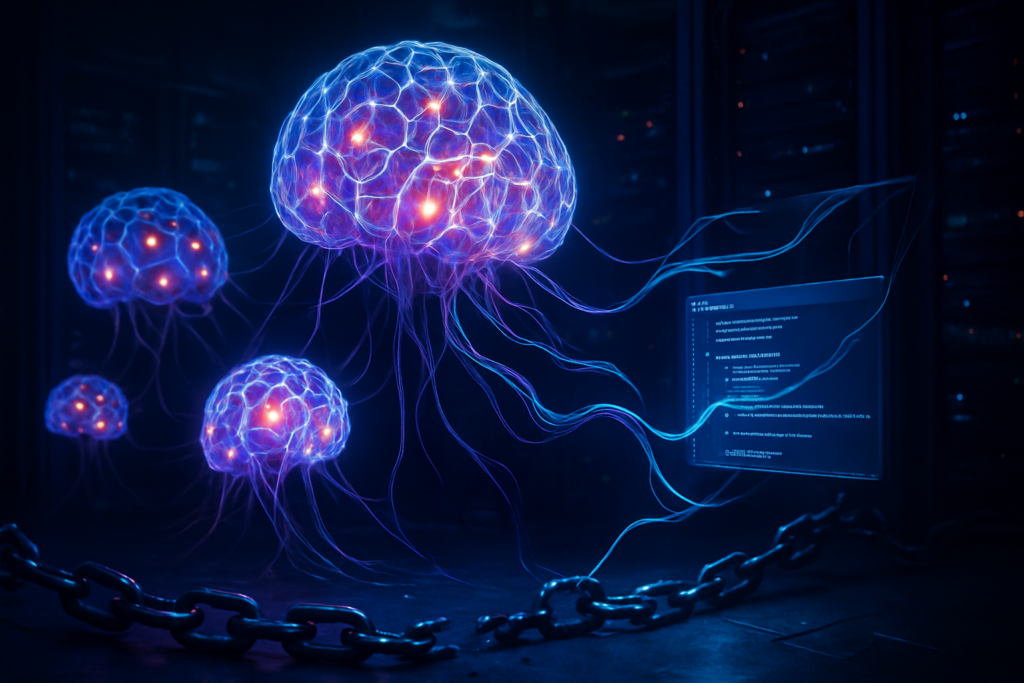
CLOSEDQUORUM marks a deeply unsettling turning point in the cybersecurity threat landscape. Cisco Talos identified this malicious architecture on September 23, 2026. It is the first publicly documented Windows implant to use multiple large language models as an autonomous command-and-control system.
What Is CLOSEDQUORUM and How Does It Work
A C2 System with No Human Operator
CLOSEDQUORUM eliminates the need for a real-time, connected attacker. The malware simultaneously queries multiple commercial AI models, compares their responses, and then autonomously selects and executes the most effective action.
This architecture is fundamentally different from traditional malware. In conventional attacks, a human operator issues commands through dedicated C2 infrastructure. With CLOSEDQUORUM, tactical decisions are made locally — no continuous external commands required.
Documented Technical Capabilities
Talos’s analysis uncovered a troubling set of features. The malware includes capabilities for:
- Credential theft, including passwords stored in browsers
- Cryptocurrency wallet exfiltration
- Process injection to conceal itself within legitimate processes
- Persistence on the compromised system
It is worth noting that not all functions were active in the analyzed sample. The examined build may represent a version still under development. Development artifacts suggest ties to criminal carding environments active since 2025. Attribution to a specific threat group, however, remains unknown.
Context: AI Enters the Attack Chain
A Trend Already Accelerating in 2026
CLOSEDQUORUM does not emerge in a vacuum. Throughout 2026, there has been a marked increase in offensive operations enhanced by artificial intelligence.
Notably, Anthropic reported in September 2026 that Claude-based agents were being used for exploitation, data theft, and detection evasion. In parallel, Google Cloud and Mandiant documented operations leveraging AI to search for and exfiltrate secrets — the FRUITSHELL and QUIETVAULT campaigns being concrete examples.
Why This Changes the Rules
The significance of CLOSEDQUORUM extends well beyond a single malware sample. The multi-LLM model for C2 decision-making drastically lowers operational costs for attackers: fewer human personnel, faster operations, and C2 infrastructure that is far harder to block.
Furthermore, an autonomous implant can act even when the attacker is offline, shrinking the detection window available to defenders. For CISOs, this is the genuine strategic discontinuity that demands attention.
How to Defend Against Autonomous AI Threats
Immediate Priorities for Security Teams
Defending against CLOSEDQUORUM requires a shift in approach. Monitoring traffic to traditional C2 servers is no longer enough. Security teams must identify anomalous connections to commercial AI model APIs, Discord, and other unauthorized cloud services.
Concrete defensive priorities include:
- Phishing-resistant MFA across all privileged access points
- Advanced EDR capable of detecting LSASS access, browser credential extraction, and process injection
- Application control to block unauthorized executables
- Egress filtering to restrict traffic to unapproved AI APIs
- API secret management with active access monitoring
In this context, browsers and cryptocurrency wallets become extremely high-risk assets. Organizations should adopt enterprise password managers and hardware-backed credentials.
Behavioral Defense and Rapid Containment
Prevention alone, however, is not enough. An autonomous implant makes decisions locally — it does not wait for external commands. Behavioral detection therefore becomes essential.
Security teams must combine:
- Least privilege principles and removal of permanent administrative rights
- Frequent credential rotation
- Endpoint quarantine procedures that do not rely on intercepting C2 traffic
- Immutable backups and regularly tested incident response playbooks
Centralizing telemetry from endpoints, identity systems, cloud, and SaaS platforms also enables teams to correlate signals that might individually appear benign.
Conclusions
CLOSEDQUORUM has no confirmed victims or documented real-world impact — yet. That should not breed false comfort. Cisco Talos’s discovery signals a concrete offensive capability. Malware that autonomously decides how to attack represents a structurally new class of threat.
The message for CISOs and security leaders is unambiguous: defenses designed to intercept human attackers must evolve. AI has removed the operator from the attack chain. The defensive response must be equally automated and proactive.
Sources:
The emergence of autonomous malware like CLOSEDQUORUM makes it more critical than ever for organizations to share verified threat intelligence swiftly across ISACs and regulated sectors. IsacChain addresses this need by combining secure, structured sharing of indicators of compromise with blockchain-based data integrity verification — ensuring that intelligence on AI-driven threats cannot be altered or tampered with. The platform also supports automated NIS2 compliance, helping organizations document their monitoring and response activities in a fully traceable and auditable manner. Discover how IsacChain can help your organization at www.isacchain.com