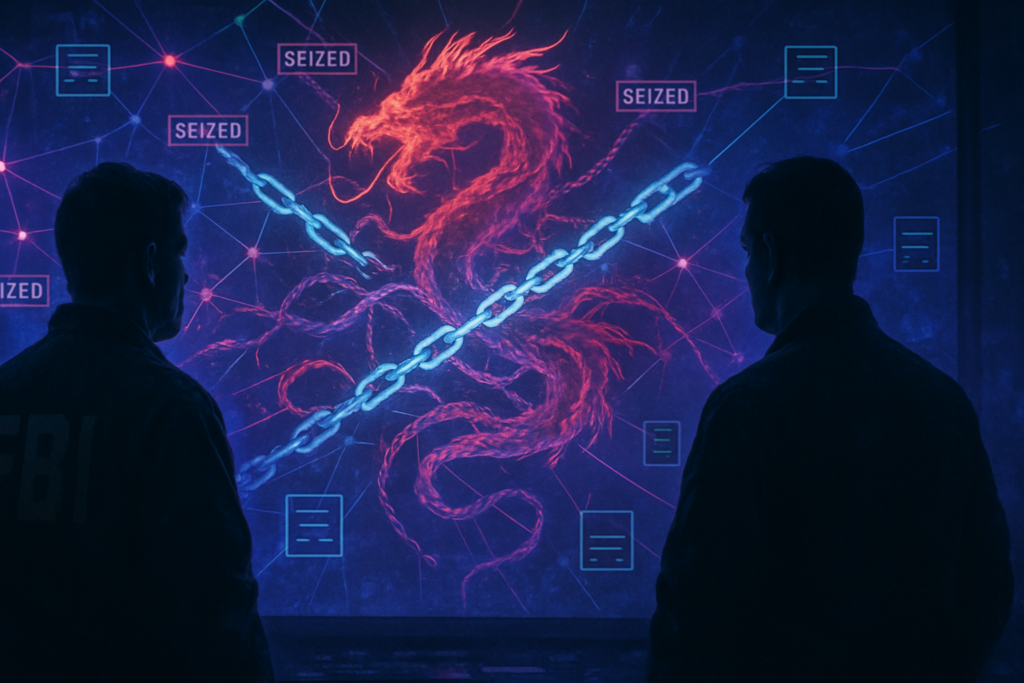
The FBI has delivered a major blow to Flax Typhoon, the Chinese government-sponsored hacking group. On October 8, 2026, the federal agency and the U.S. Department of Justice moved simultaneously to seize seven operational domains. Those domains underpinned the MicroScan and FishHub platforms, both used to conduct attacks against critical infrastructure worldwide.
The FBI’s Operation Against Flax Typhoon
Seven Domains Seized in a Single Strike
The operation cut straight to the heart of the group’s digital infrastructure. The Department of Justice coordinated the simultaneous takedown of all seven domains, instantly rendering both platforms inoperable.
MicroScan functioned as a vulnerability-scanning tool, while FishHub was purpose-built for phishing campaigns and credential harvesting. Together, the two platforms formed a sophisticated, end-to-end offensive ecosystem.
The seized domains served as the group’s central command-and-control backbone. Without them, Flax Typhoon lost its immediate operational capability. Analysts are already describing the seizure as one of the most significant enforcement actions against Chinese cyber espionage in recent years.
Who Is Flax Typhoon?
Flax Typhoon is a threat actor formally attributed to the Chinese government by U.S. authorities, who classify it as a nation-state actor operating with advanced resources and clearly defined strategic objectives.
Yet the group’s reach extends well beyond U.S. borders. Documented attacks have targeted infrastructure across multiple continents, underscoring the truly global ambition of China’s cyber operations.
The Targets: A Global Assault on Critical Infrastructure
Victims Across the United States and Asia
Flax Typhoon’s target selection was both broad and deliberate. Confirmed victims include a U.S. electric utility — power grids being among the most sensitive assets any nation can possess.
At the same time, the group struck airports in Japan and Poland. Compromising transportation infrastructure can produce cascading consequences: delays, operational disruptions, and data breaches capable of paralyzing entire economies.
In Asia, Taiwanese universities were also in the crosshairs. These institutions are hubs of advanced research, and the theft of academic and technological data fits squarely within a long-running strategy of industrial espionage.
A Multinational NGO Also Targeted
Among the confirmed victims was a multinational non-governmental organization — a detail that carries particular weight. NGOs frequently operate in sensitive geopolitical environments and handle highly confidential information.
Their inclusion on Flax Typhoon’s target list makes clear that the group is not solely focused on industrial assets. Any entity with access to strategic or diplomatic data is a viable target, and the breadth of victim selection points to a patient, long-term intelligence-gathering strategy.
Implications for Critical Infrastructure Security
How MicroScan and FishHub Worked in Tandem
The two platforms were designed to operate in concert. MicroScan would first map vulnerabilities across target systems; FishHub would then exploit those weaknesses through precision phishing campaigns. This two-phase approach is especially dangerous because it allows attackers to survey the terrain before striking with surgical accuracy — leaving compromised organizations little chance of detecting the intrusion in time.
Both platforms were also engineered to keep a low profile. Malicious traffic was deliberately blended with legitimate network activity, making detection extremely difficult even for seasoned security teams.
What Organizations Must Do Now
Seizing the domains does not eradicate the threat at its root. Flax Typhoon commands sufficient resources to rebuild its infrastructure, and organizations cannot afford to wait for the next law enforcement action before taking steps to protect themselves.
CISOs and security leaders must immediately reassess their exposure. Rigorous patch management, regular phishing simulations, and continuous monitoring for anomalous traffic are non-negotiable priorities. Sharing threat intelligence through trusted platforms like IsacChain also accelerates collective response and reduces the window of opportunity for attackers.
The deeper lesson, however, is systemic. Attacks on critical infrastructure demand a coordinated response spanning both public and private sectors. Long-term, sustained international cooperation between agencies and organizations is the only genuinely effective line of defense.
Conclusions
The FBI’s operation against Flax Typhoon sends an unambiguous message: the United States is prepared to take offensive action in cyberspace. Even so, the Chinese threat to critical infrastructure remains structural and persistent.
Organizations worldwide should assume they are potential targets. Prevention, proactive threat intelligence sharing, and incident response readiness are no longer optional — they are the only weapons that truly work.
Sources:
- BleepingComputer – FBI disrupts Chinese hacking tools
- U.S. Department of Justice – Official Statement
- AP News – FBI and DOJ Act Against Chinese Hackers
Source: Original article
Operations like the takedown of Flax Typhoon highlight just how critical it is for organizations to share threat intelligence on nation-state actors quickly and reliably. IsacChain provides a secure, verified environment for sharing threat information, with automated NIS2 compliance built directly into operational workflows and blockchain-backed traceability for every data point exchanged among members. In a landscape where state-sponsored groups are actively targeting critical infrastructure across multiple continents, a collective and coordinated response is the only truly effective defense. Discover how IsacChain can help your organization at www.isacchain.com