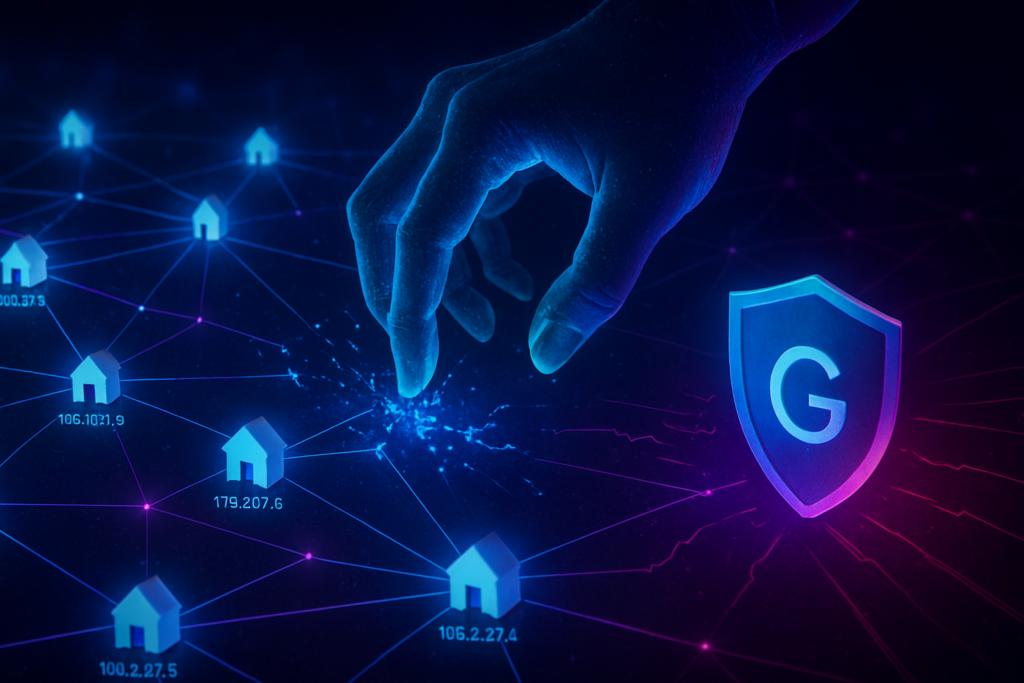
Google has stepped up its fight against residential proxy networks being exploited for malicious purposes. The latest operation targeted IPIdea, one of the major residential proxy providers implicated in illicit activities on a global scale.
This action marks a new chapter in Google’s broader strategy against the abuse of network infrastructure. Residential proxy networks are increasingly weaponized by threat actors to conceal malicious traffic and evade detection.
What Are Residential Proxy Networks and Why Are They Dangerous
Residential proxy networks route traffic through real household devices, making them exceptionally difficult to detect and block.
The Abuse Mechanism
Residential IP addresses appear legitimate to security systems, meaning malicious traffic looks as though it originates from ordinary home users.
Threat actors exploit these networks for a wide range of activities:
- Credential stuffing: large-scale testing of stolen credentials
- Unauthorized scraping: illicit data harvesting from web platforms
- Ad fraud: generating artificial traffic to manipulate advertising metrics
- Geo-restriction evasion: bypassing regional content and access controls
The problem extends well beyond tech platforms. CISOs across every industry sector should treat these networks as active attack vectors against their own authentication systems.
Google’s Operation Against IPIdea
Google’s Threat Intelligence Group (GTIG) identified IPIdea as a central node within the malicious proxy ecosystem and moved decisively to disrupt its operations.
Technical and Legal Actions Taken
Google adopted a multi-layered approach. First, it severed IPIdea’s infrastructure from access to its own services. In parallel, it shared intelligence with relevant authorities and industry partners.
It is worth noting that this is not the first operation of its kind. Google has previously conducted similar disruptions against other abusive residential proxy network providers, steadily building a significant operational precedent.
IPIdea operated at global scale, involving millions of IP addresses distributed across dozens of countries. That geographic spread made attack attribution particularly complex.
The Role of the Google Threat Intelligence Group
GTIG continuously monitors the evolution of cybercriminal infrastructure. The identification of IPIdea was the result of in-depth analysis of anomalous traffic patterns, with the team tracking large-scale abuse over an extended period before taking action.
Google also published the indicators of compromise (IoCs) associated with the operation — a transparency measure that helps the broader security community mount effective defenses.
Implications for Enterprise Security
Residential proxy networks pose a growing challenge for corporate security teams. Traditional IP reputation-based blocking is frequently ineffective against these vectors, since residential addresses carry an inherent appearance of legitimacy.
How to Defend Against This Type of Threat
Organizations must rethink their defensive strategies. Relying solely on IP blacklists is no longer sufficient — residential proxies continuously rotate addresses, rendering static blocks useless.
The most effective countermeasures include:
- Behavioral analysis: detecting anomalous patterns regardless of source IP
- Advanced rate limiting: throttling requests per session and browser fingerprint
- Robust MFA: rendering stolen credentials operationally worthless even when exfiltrated
- Shared threat intelligence: integrating feeds such as those produced by Google GTIG
CISOs should seriously evaluate whether their authentication systems are adequately hardened against credential stuffing attacks facilitated by residential proxies.
The Broader Picture: Dismantling a Criminal Ecosystem
Google’s actions are not isolated incidents — they are part of a deliberate long-term strategy. The goal is to drive up the operational cost for cybercriminals who abuse network infrastructure.
That said, taking down a single provider does not solve the underlying problem. New services emerge quickly to replace those that have been disrupted. Sustained, continuous pressure remains the only viable long-term response.
Conclusion
Google’s disruption of IPIdea underscores an important trend: major technology platforms are taking an increasingly active role in combating cybercriminal infrastructure. Residential proxy networks remain a concrete and evolving threat to organizations of every size. An effective response demands close collaboration between vendors, platforms, and internal security teams.
Sources
Source: Original article
Google’s takedown of IPIdea highlights just how critical timely threat intelligence sharing has become for organizations worldwide. Platforms like IsacChain enable companies to exchange indicators of compromise securely and with full traceability, backed by blockchain verification that guarantees the integrity of every shared data point. In a regulatory landscape shaped by NIS2 compliance requirements, IsacChain’s automated compliance capabilities allow security teams to respond swiftly to emerging threats — such as malicious residential proxy networks — significantly reducing exposure windows. Discover how IsacChain can help your organization at www.isacchain.com