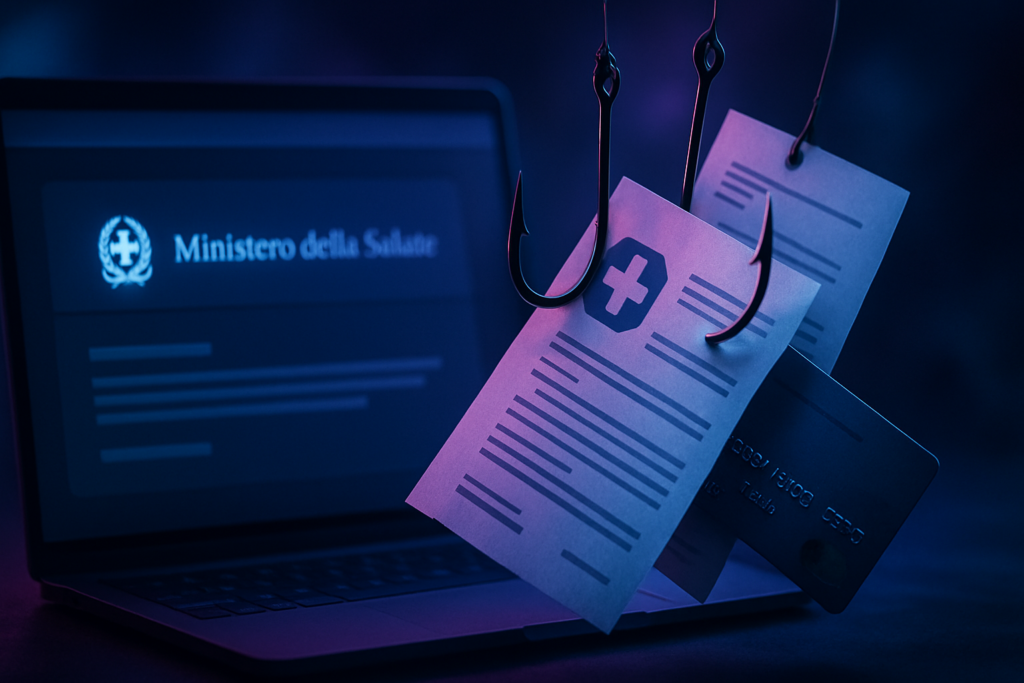
A new phishing campaign impersonating Italy’s Ministry of Health is actively targeting Italian citizens. The attackers are posing as the national health institution to steal personal and financial data. CERT-AgID officially raised the alarm on August 21, 2026.
How the Fake Healthcare Refund Scam Works
The Email Attack Mechanism
Victims receive a fraudulent email that appears to come from the Ministry of Health. The subject line typically reads something like “You are entitled to a refund” or similar variations.
The message uses the Ministry’s official logos and visual identity, making it look convincingly legitimate. Many users lower their guard when faced with what appears to be an official institutional communication.
The email then urges recipients to click a link, which redirects them to a fake webpage. Once there, users are prompted to enter personal details and payment card information.
What Happens After the Click
Once users land on the malicious site, they are presented with what looks like a legitimate form. It collects full name, Italian tax code, and banking details — all of which are immediately transmitted to the attackers.
Victims consequently face serious risks including identity theft and financial fraud. The damage can materialize very quickly, with no visible warning signs at the point of compromise.
Official Confirmation: CERT-AgID and the Ministry of Health
CERT-AgID’s Role in Detection
CERT-AgID identified and documented this campaign, publishing a detailed technical analysis of the threat. The report outlines the attackers’ operational methods and recurring patterns.
Notably, CERT-AgID highlights that this campaign fits within a broader scheme. Similar operations exploiting the Ministry of Health’s brand were already observed in 2025. The refund narrative — tied to Italy’s National Health Service (SSN) — is a well-tested social engineering hook that keeps resurfacing.
Additionally, the CSIRT of the Umbria Region issued a specific alert, and consumer watchdog Altroconsumo confirmed the attack pattern. Multiple independent sources are converging on the same threat typology.
The Ministry of Health’s Official Stance
The Ministry of Health has responded with clear public communications, stressing one fundamental point: the Ministry never sends emails to issue refunds. Any message containing such content should be treated as a scam.
Despite these warnings, many citizens remain unaware. The campaign continues to claim new victims, making the rapid dissemination of accurate information a critical component of the defense strategy.
Historical Context and Security Implications
A Well-Established Brand Impersonation Pattern
Phishing campaigns targeting the Ministry of Health are far from isolated incidents. Similar operations have recurred cyclically for years. Attackers deliberately exploit healthcare themes because they generate a powerful combination of institutional trust and emotional urgency.
No specific threat actor has been attributed to this campaign. The perpetrators are broadly described as financially motivated cybercriminals. What is clear, however, is that these groups strategically time their operations to coincide with periods of heightened public attention to health-related matters. Public healthcare is an exceptionally effective social engineering vector.
Why These Campaigns Keep Working
Several factors explain the continued success of these scams. First, the emails are visually polished and professionally designed. Second, the promise of a financial refund triggers an immediate emotional response. Third, the vast majority of users do not verify the actual sender address behind the display name.
User education therefore remains the first line of defense. Organizations must train employees and citizens alike to recognize fraudulent emails. CISOs should incorporate these real-world scenarios into their security awareness programs.
Operational Recommendations
The steps to take are clear and immediate:
- Never click on links in unsolicited emails promising healthcare refunds.
- Always verify the actual sender address, not just the display name.
- Navigate directly to the official Ministry of Health website for any verification.
- Report suspicious emails to CERT-AgID through official channels.
- Update corporate email security policies to filter these attack patterns.
In summary, phishing campaigns impersonating the Ministry of Health represent a concrete and active threat. Awareness remains the most effective tool to neutralize it.
Sources
- CERT-AgID – Phishing falso rimborso ticket sanitario
- CERT-AgID – False comunicazioni Ministero della Salute
- Ministero della Salute – Allerta truffa rimborsi
- Ministero della Salute – Ancora false email su rimborsi
- CSIRT Regione Umbria – Cybersecurity Alert
- Altroconsumo – Truffa email SSN
- CERT-AgID – Tag Ministero della Salute
Source: Original article
Campaigns like this Ministry of Health phishing operation underscore just how critical timely threat intelligence sharing is between public and private organizations. Platforms like IsacChain enable the secure distribution of indicators of compromise associated with these scams, automate NIS2 compliance verification, and ensure the integrity of shared information through blockchain-based traceability. In a landscape where healthcare institutions are repeat targets, having access to a shared and verifiable intelligence ecosystem can significantly cut response times and limit the blast radius of these attacks. Discover how IsacChain can help your organization at www.isacchain.com