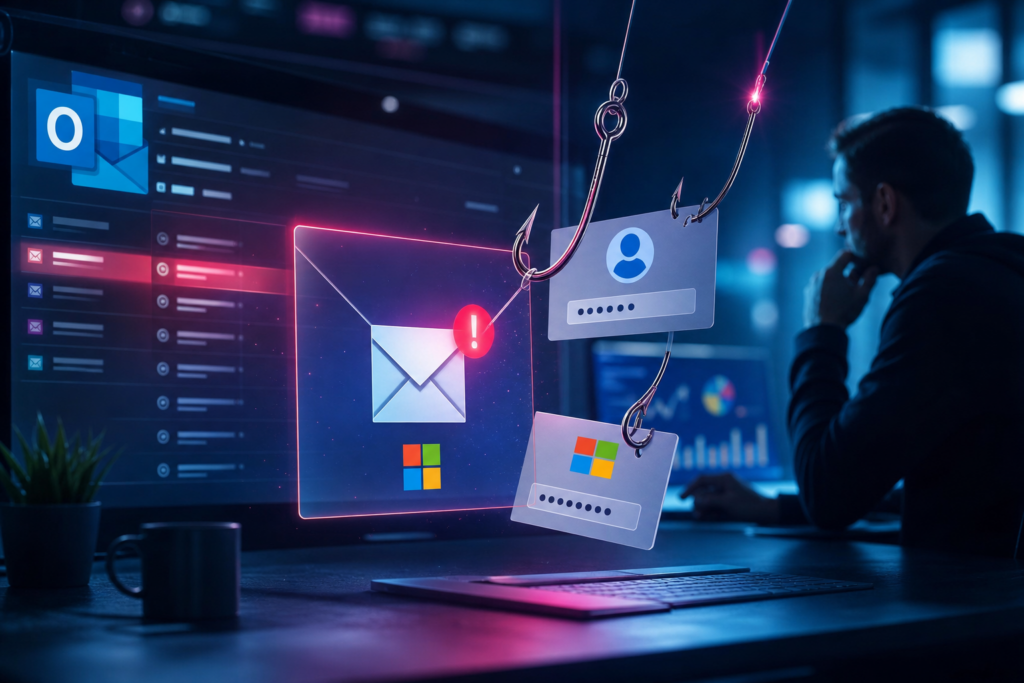
On November 13, 2026, a large-scale Microsoft 365 credential phishing campaign was launched against organizations worldwide. Threat actors exploited an actual platform outage — which had begun the previous day — to deceive users and administrators alike. Microsoft Threat Intelligence detected and documented the operation swiftly.
How the Attack Worked: Manufactured Urgency, Real Context
How Hackers Used the Outage as Bait
What made this campaign particularly dangerous was its sheer credibility. Attackers sent emails impersonating official Microsoft 365 Service Health notifications, claiming that emails queued during the Exchange Online outage would be permanently deleted within 24 hours.
To allegedly “recover” their messages, recipients were prompted to click a malicious recovery link — all while the actual outage was still ongoing. The manufactured time pressure was deliberately engineered to bypass critical thinking.
One technical detail stands out as especially deceptive. The phishing emails included the real Microsoft incident identifier: EX1550543 — the authentic tracking code associated with the Exchange Online disruption. By citing this legitimate reference, the fraudulent messages became nearly indistinguishable from official Microsoft communications.
The Original Outage Was Not a Cyberattack
Microsoft confirmed a critical point: the November 12 outage was not caused by a cyberattack. It was an independent technical incident. The threat actors did not trigger the disruption — they simply observed it and opportunistically weaponized it in real time.
As a result, affected organizations faced a doubly complex situation: managing a legitimate service disruption on one front, while simultaneously being targeted by a phishing campaign that exploited that very disruption on another.
Who Was Targeted and What We Know About the Attackers
Cross-Sector Targeting
The Microsoft 365 credential phishing campaign hit organizations across the globe, with no single vertical industry identified as the primary target. Healthcare, finance, manufacturing, and public sector entities were all potentially exposed.
This indiscriminate targeting is a hallmark of attacks that exploit widely adopted cloud platforms. With millions of organizations relying on Microsoft 365, any entity dependent on Exchange Online becomes a potential victim the moment a service disruption occurs.
No Public Attribution
Microsoft has not attributed the activity to any known threat group. No criminal organization or state-sponsored actor has been identified. While analysis confirmed the operation was coordinated and high-volume in nature, neither successful credential harvesting nor malware delivery has been officially confirmed.
The absence of attribution does not diminish the severity of the incident — it simply reflects a gap in available intelligence. Security teams must operate without a clearly defined adversary profile, which complicates both response and future prevention efforts.
How to Defend Against These Attacks: Microsoft’s Recommendations
Authentication and Access Controls
The first line of defense is phishing-resistant multi-factor authentication. Microsoft strongly recommends deploying FIDO2 keys or passkeys for privileged accounts. Traditional MFA — whether SMS-based or app-based — can be circumvented through advanced phishing techniques. FIDO2 eliminates this vulnerability at the structural level.
Alongside stronger authentication, organizations should disable legacy authentication protocols, enforce the principle of least privilege, and configure conditional access policies. These are not advanced measures reserved for large enterprises — they are baseline requirements for any organization running Microsoft 365 in a business environment.
Email Filters, Safe Links, and Incident Response
Microsoft specifically recommends reviewing and configuring Safe Links policies. This feature analyzes URLs at the moment of click — even if the link appeared benign when the email was first received. Real-time URL analysis is essential against campaigns that dynamically redirect victims after delivery.
Security teams should also actively monitor email, URL, and click telemetry within Microsoft 365, and immediately investigate any users who interacted with suspicious links following an incident of this nature.
One organizational recommendation deserves particular emphasis. Service health notifications must be verified exclusively through the Microsoft 365 Admin Center — never by clicking links received via email. This rule must be clearly communicated to all employees, not just IT staff.
Finally, organizations should update their incident response playbooks to explicitly classify service outage periods as elevated social engineering risk windows. Communications and security teams must coordinate actively during any significant service disruption.
Conclusions
This Microsoft 365 credential phishing campaign marks a significant tactical evolution. The attackers did not exploit a software vulnerability — they exploited trust, urgency, and real operational context. Effective defense demands ongoing user education, up-to-date technical controls, and clearly defined organizational processes.
Sources:
Source: Original article
Campaigns like this one underscore how critical it is for organizations to have secure, verifiable channels for sharing threat intelligence in real time. IsacChain enables ISACs and enterprise organizations to exchange indicators of compromise and active phishing alerts through a blockchain-verified platform that guarantees the integrity of shared information. Its built-in automated NIS2 compliance functionality also allows teams to document incident response actions without added administrative overhead. Discover how IsacChain can help your organization at www.isacchain.com