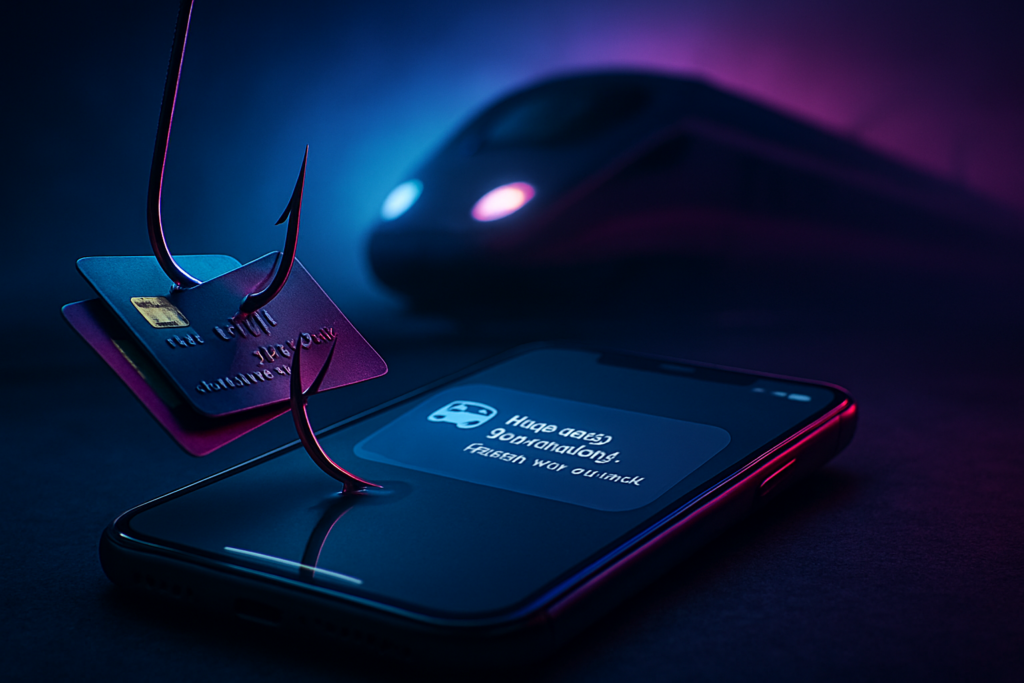
A Trenitalia smishing campaign is actively targeting Italian rail passengers. Fraudsters are impersonating the well-known train operator to steal personal information and banking credentials. The alarm has been raised by multiple institutional sources between 2024 and 2026.
How the Scam Works: Anatomy of the Attack
The Lure SMS
The victim receives a text message that appears to come from Trenitalia. The message promises a cash refund, delivered in an urgent and convincing tone.
Embedded in the text is a link. That link redirects to a fraudulent website meticulously crafted to mirror Trenitalia’s visual identity — complete with official logos and brand colours.
The message also exploits the trust passengers instinctively place in the Trenitalia brand. This psychological element is central to the attack’s effectiveness.
The Data Harvesting Chain
Once on the fake site, the user is walked through a step-by-step process. First, they are prompted to enter their phone number. Next, they provide credit or debit card details.
Finally, the site requests a so-called verification payment — a fictitious charge whose real purpose is to validate the card and capture the victim’s financial credentials.
The result is a double loss for the victim: personal data is compromised, and money is stolen through the fraudulent charge.
Timeline of Sightings: 2024 to 2026
First Alert: CSIRT Toscana, March 2024
The CSIRT of the Tuscany Region issued the first warning in March 2024, describing an active phishing campaign in which criminals leveraged Trenitalia’s logos and visual branding to deceive victims.
At that stage, the attack was primarily focused on harvesting personal data, though credit card information was already in the crosshairs. The campaign displayed a structured and premeditated character.
The 2026 Resurgence
The threat, however, did not fade. In July 2026, new Trenitalia smishing cases were documented and reported by RaiNews. The attack’s structure remained broadly similar, but its sophistication had increased.
The campaign’s timeline is worth highlighting. Two years of sustained activity point to an unusual degree of persistence, suggesting that those behind it have found the scheme both profitable and difficult to disrupt.
Who Is Behind the Attack and What Risks Does It Pose?
Attribution: No Group Identified
To date, no specific threat actor has been formally identified. Institutional sources have not attributed the campaign to any known group. The operation may be the work of opportunistic criminal actors.
The absence of attribution complicates the response: without links to known infrastructure, proactive prediction and prevention become significantly harder.
Risks for Victims and Organisations
The risks for victims are concrete and immediate. At the same time, Trenitalia itself faces reputational damage as its brand is weaponised without its consent.
For individual citizens, the consequences include:
- Identity theft through stolen personal data
- Financial fraud via unauthorised charges
- Credit card compromise, requiring card cancellation and replacement
Frequent rail passengers are particularly attractive targets. Their familiarity with Trenitalia services makes them more likely to lower their guard when faced with what appears to be a legitimate communication.
How to Protect Yourself from Trenitalia Smishing
Recognising the Warning Signs
There are clear indicators that help identify these fraudulent messages. The first is an unsolicited promise of a refund. The second is the presence of a shortened or suspicious link within the SMS.
Critically, Trenitalia never requests verification payments via text message. That fact alone should trigger an immediate red flag.
Security Best Practices
The following actions are recommended for both individuals and organisations:
- Never click on links contained in unexpected SMS messages
- Always verify the website URL before entering any data
- Contact Trenitalia directly through official channels if in doubt
- Report suspicious messages to your mobile operator and to the Polizia Postale
- Monitor bank statements closely after any suspicious interaction
Organisations should also incorporate smishing scenarios into their security awareness programmes. The human factor remains the most exploited attack vector, and training is among the most effective defences.
Sources
- CSIRT Toscana – Trenitalia Phishing Campaign Alert
- CSIRT Toscana – Trenitalia Tag Archive
- RaiNews – Fake SMS Promises Trenitalia Refund: It’s a Scam
- ACN – Trenitalia-Themed Smishing Campaign
Smishing campaigns like the one targeting Trenitalia passengers underscore how critical timely threat intelligence sharing is between organisations and institutions. Platforms like IsacChain enable the secure, verified exchange of indicators of compromise across ISACs and operators, while simultaneously supporting NIS2 compliance in an automated and auditable way. Blockchain-based verification ensures the integrity and provenance of shared information, reducing the risk of acting on tampered or unreliable data. Discover how IsacChain can help your organization at www.isacchain.com