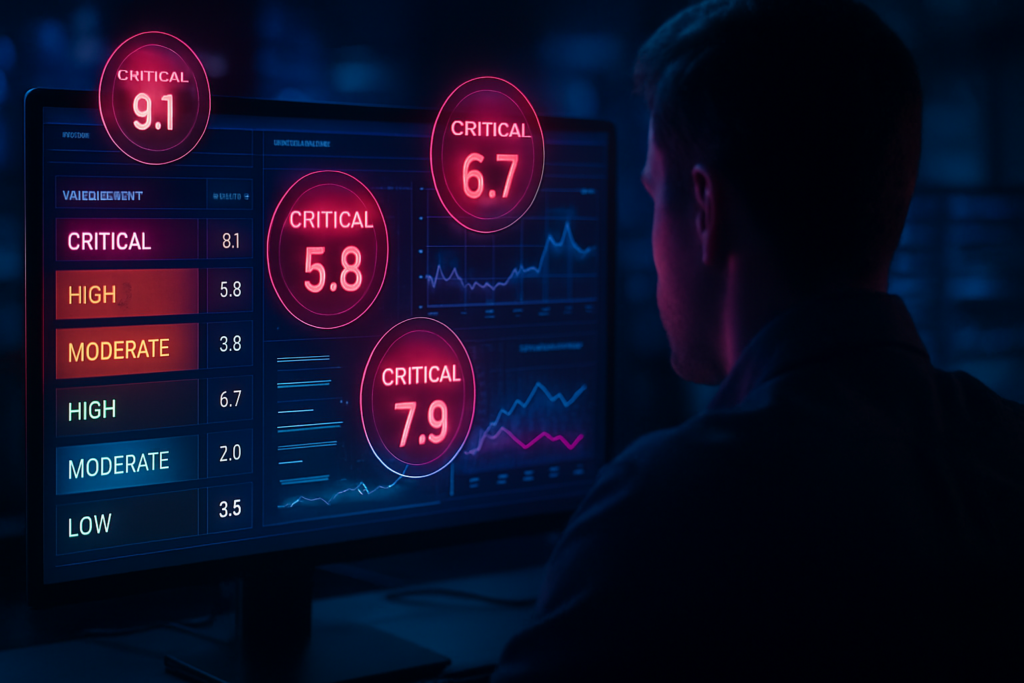
Vulnerability prioritization has become one of the most pressing challenges in cybersecurity. An analysis published by The Hacker News on September 11, 2026 challenges a widespread assumption: that vulnerabilities flagged as “critical” by scanning tools automatically represent the highest risk to an organization. That is not always the case.
The Paradox of Severity Scores
Security teams routinely rely on CVSS scores to decide where to focus their efforts. This approach, however, has a significant flaw. A high score does not equal a high real-world risk.
When a Critical Vulnerability Is Not the Priority
A vulnerability carrying a CVSS score of 9.8 can appear alarmingly urgent. Yet if it sits in a completely isolated network segment, its actual risk drops dramatically. An attacker cannot reach it. Cannot exploit it. Theoretical danger does not translate into operational danger.
As a result, teams that focus exclusively on scores risk wasting resources. They burn energy patching vulnerabilities that are effectively unreachable. Meanwhile, other flaws — rated “medium” — remain exposed and exploitable.
It is worth stressing that this distortion is not a technical error. It is a methodological one. Severity measures potential damage. It does not measure the likelihood of exploitation in a specific context.
Real Risk Hides in Attack Paths
The true challenge of vulnerability prioritization is not about individual assets. It is about the paths an attacker can traverse across the infrastructure.
Chaining: How Medium Vulnerabilities Become Dangerous
Attackers rarely exploit a single vulnerability in isolation. They chain multiple weaknesses together in sequence — a technique known as vulnerability chaining.
A practical example: a medium-severity vulnerability on an internet-facing server. On its own, the damage is limited. Combined with a privilege escalation and lateral movement, it can open a direct path to the heart of the infrastructure.
In that scenario, the medium vulnerability becomes the critical entry point — not according to its score, but according to the attack path it enables.
Organizations that fail to map these paths operate with a partial view of their exposure. They see the nodes of the graph. They do not see the edges connecting them.
The Importance of Continuous Visibility
The principle is straightforward: you cannot defend what you cannot see. A related article published on The Hacker News Awards Blog reinforces this point. Continuous visibility into exposures is a prerequisite for effective defense.
This means monitoring not only known vulnerabilities, but understanding how they relate to one another — and continuously updating that picture, because infrastructure changes every day.
How to Rethink Vulnerability Prioritization
Shifting the approach to vulnerability prioritization demands a cultural change before a technological one. CISOs and security leaders must drive this transformation from the top down.
Continuous Exposure Validation
The first step is introducing continuous validation. Knowing a vulnerability exists is not enough. Teams must verify whether it is reachable, whether it is exploitable, and whether it forms part of an active attack path.
Tools such as Breach and Attack Simulation (BAS) platforms and Attack Surface Management solutions support this process. They simulate the behavior of a real attacker and identify the most dangerous paths — regardless of CVSS scores.
Risk-Based Remediation
The second step is redefining remediation criteria. The question should no longer be: “What is the score of this vulnerability?” It should be: “Does this vulnerability sit on a path leading to a critical asset?”
Organizations should also factor in operational context. An internet-facing production server carries a very different risk profile from an isolated test server. The score does not change. The risk does.
Security teams should also work closely with IT and business teams. A shared understanding of the infrastructure is essential for accurate risk assessment.
Conclusion: Severity Is a Starting Point, Not a Destination
Vulnerability prioritization based solely on severity is an incomplete strategy. CVSS scores remain useful — they provide a quick reference point. But they do not tell the whole story.
The most effective teams integrate severity ratings with attack path analysis, exposure validation, and operational context. This approach cuts through the noise, focuses resources where risk is real, and delivers far more effective protection for the organization.
Sources:
- The Hacker News – Your Critical Vulnerabilities Might Not Be Your Biggest Risk
- The Hacker News – Your Risk Scores Are Lying
- The Hacker News – Why CVSS Scores Don’t Tell the Real Story
- The Hacker News Awards Blog – You Can’t Defend What You Can’t See
- The Hacker News – How Breaches Start
- No Hack Me
- Security Portal CZ
- Dev Radar
- CERT EU – Security Advisories 2026
Source: Original article
Effective vulnerability prioritization requires more than internal analysis — it demands structured threat intelligence sharing across organizations within the same sector. IsacChain enables the secure, verified exchange of indicators of compromise and exposure data among ISAC members, while supporting automated NIS2 compliance through integrated reports and audit trails. Every piece of shared data is tracked and authenticated via blockchain verification, ensuring the integrity and non-repudiation of information. Discover how IsacChain can help your organization at www.isacchain.com