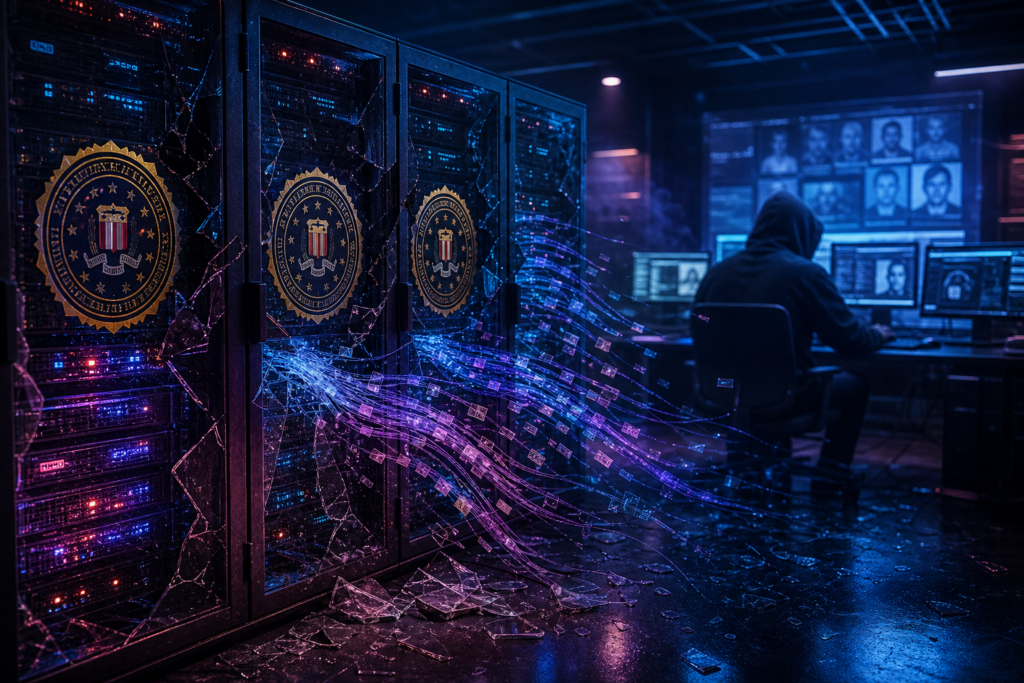
An unknown threat actor has compromised the FBI’s NCIC — the National Crime Information Center, the backbone of U.S. law enforcement data infrastructure. The incident was reported on November 21, 2026, with the discovery believed to have occurred in the days preceding publication.
The FBI has launched an internal investigation. However, the agency has not issued any official public confirmation. The method of access used by the attackers remains unknown.
What Is the NCIC and Why Is It a Critical Target
A Database at the Heart of American Law Enforcement
The National Crime Information Center is one of the most sensitive resources in the entire U.S. federal government. It holds records on arrest warrants, criminal histories, missing persons, and stolen property. Thousands of federal, state, and local agencies rely on it every single day.
In this context, a breach of the NCIC doesn’t just affect the FBI. It potentially implicates every agency connected to the system. The true scope of the consequences depends entirely on what was accessed or exfiltrated.
As of now, however, no official confirmation has established any data loss. It remains unclear whether records were viewed, modified, or exported. The impact on system availability is also unconfirmed.
A Second Attack Within Months
One detail deserves particular attention. According to multiple independent reports, this may not be the FBI’s first recent breach. A separate incident is said to have occurred in the months prior. The two events appear distinct, though no confirmed connection has been established.
The clustering of incidents targeting federal law enforcement infrastructure is nonetheless concerning. That said, there is insufficient evidence at this stage to declare a systematic pattern. Attribution to any specific group remains impossible.
Threat Analysis: Attribution Still Unknown
No Claimed Responsibility, No Confirmed Motive
The identity of the threat actor behind this breach is entirely unknown. No group has claimed responsibility. Available reports offer no links to known campaigns or prior activity.
Equally, the intrusion method has not been disclosed. The exploited vulnerability — if any — is unknown. It remains unclear whether access was gained through compromised credentials, a technical exploit, or another attack vector entirely.
In this environment, attributing the attack to a nation-state, criminal syndicate, or hacktivist group would be premature. Security managers should treat attribution as an open risk variable. Defensive decisions must not be contingent on identifying the adversary.
Why Law Enforcement Systems Are High-Value Targets
Law enforcement databases aggregate extraordinarily sensitive information. Identities, warrants, active investigations, confidential sources — it all flows through these systems. For an attacker, access to this data can be enormously valuable.
Furthermore, their deeply interconnected nature makes them especially exposed. A single point of compromise can ripple across hundreds of linked agencies. This dramatically amplifies the potential damage of any single incident.
Recommendations for CISOs and Security Leaders
Priority Controls When Technical Details Are Unknown
When the attack vector is unknown, defensive strategy must be broader. You cannot patch an unidentified vulnerability. You can, however, reduce your overall attack surface.
Immediate priorities include:
- Phishing-resistant multi-factor authentication for all administrators and connected agencies
- Least-privilege and just-in-time access, with frequent entitlement reviews
- Network segmentation across federal, state, local, and vendor environments
- Immutable, centralized audit logs with alerts on anomalous queries or bulk data exports
- Active endpoint detection and response across all connected systems
In particular, rapid revocation of credentials and tokens must be a tested, automatable process. Every minute matters when unauthorized access may be ongoing.
Operational Resilience and Incident Response
Any organization connected to similar databases must review its business continuity plans. Those plans should include database isolation scenarios. Essential services must be capable of operating even under forced disconnection.
Independent penetration testing is equally essential. Attack path reviews should encompass connected agencies, not just the core system. Response exercises should simulate both data loss and record integrity compromise.
One often-overlooked metric is worth highlighting. The time required to determine whether records have been viewed or tampered with is just as critical as containment time. Tamper-evidence must be built into system architecture from the ground up.
Conclusions
The breach of the FBI’s NCIC is a textbook example of systemic risk in critical infrastructure. The incident remains officially unconfirmed. Technical details are absent. Yet the security implications for law enforcement infrastructure are impossible to ignore.
In the absence of certainty, the right response is to strengthen existing controls. Don’t wait for confirmation before acting.
Sources:
- BleepingComputer – FBI reportedly hacked again, this time targeting nationwide police database
- Fundy Tech – FBI reportedly probes breach of national police database
- The Kernel Wire – FBI’s police database breached in second attack within two months
Source: Original article
Incidents like the FBI NCIC breach make one thing abundantly clear: timely threat intelligence sharing between interconnected organizations is not optional — it’s critical. A single point of compromise can cascade across hundreds of linked agencies in a matter of hours. Platforms like IsacChain enable secure, structured sharing of indicators of compromise across organizations, while simultaneously supporting NIS2 compliance in an automated and fully traceable manner. Integrated blockchain verification ensures the integrity and non-repudiation of shared intelligence — an essential safeguard when the data in question relates to critical infrastructure. Discover how IsacChain can help your organization at www.isacchain.com