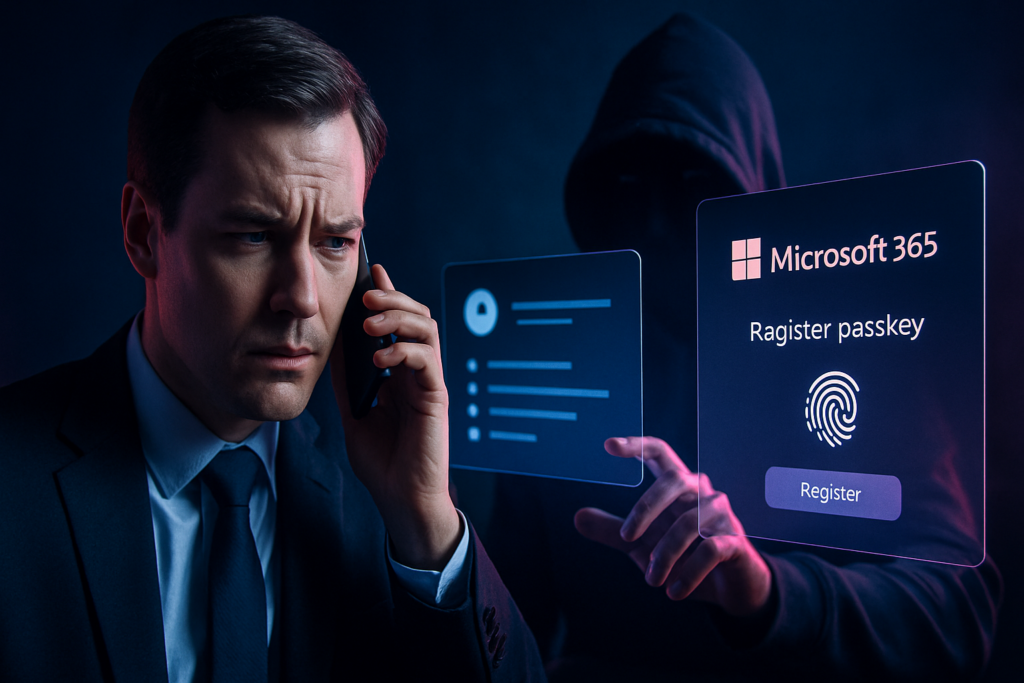
A new attack scheme targeting Microsoft 365 passkeys is hitting organizations across multiple sectors. The criminal group known as O-UNC-066 — also tracked as Pink/CL-CRI-1147 by Palo Alto Unit 42 — is exploiting fraudulent phone calls to register attacker-controlled authentication keys. The end goal: data theft and extortion.
How the Microsoft 365 Passkey Scam Works
The group has been active since April 2026. Its primary weapon is vishing: a phone call in which the attacker impersonates IT support or internal helpdesk staff.
The Compromise Chain, Step by Step
The attacker contacts the victim by phone or SMS, posing as Microsoft technical support or an internal IT colleague. The victim is then urged to complete an urgent security procedure.
A link is sent. That link leads to a spoofed Microsoft Entra page — a convincing replica of the legitimate passkey enrollment flow.
Once the user completes the process, the attacker registers a passkey under their own control on the victim’s account. From that point on, access to the Microsoft 365 account is wide open — no password, no traditional MFA required.
The critical point here is this: there is no bug in Microsoft’s platform. Attackers are abusing a legitimate authentication flow. The vulnerability lies in human behavior, not in the code.
Affected Sectors and Scale of the Threat
Confirmed victims span a remarkably wide range of industries — food and beverage, technology, healthcare, automotive, construction, and aviation have all been hit. This breadth strongly suggests opportunistic targeting, rather than a focus on any single vertical.
A Structural Problem for Cloud Identity
Microsoft 365 sits at the heart of email, file storage, and identity management in virtually every modern organization. Compromising a single account can open the door to SharePoint, OneDrive, email archives, and potentially connected downstream systems.
This threat does not exist in isolation. In May 2026, Microsoft documented an adversary-in-the-middle campaign that struck more than 35,000 users across 13,000 organizations in 26 countries. The FBI subsequently issued a warning about Kali365, a phishing-as-a-service kit distributed via Telegram that steals Microsoft 365 access tokens while bypassing MFA.
All of these attacks share the same ultimate objective: unauthorized access to cloud accounts, followed by data exfiltration or extortion.
Defending Against Passkey Attacks: What to Do Now
The defensive priority is clear: tight control over the registration of new authentication methods. Every new passkey or FIDO2 device should require verified administrative approval before it can be enrolled.
Technical Measures for Security Teams
Security teams should activate approval workflows for passkey registrations in Microsoft Entra and monitor new sign-ins from unknown devices in real time. Bulk downloads from SharePoint or OneDrive — a common post-compromise indicator — must also be flagged and investigated promptly.
Rapid revocation of suspicious sessions is equally critical. Centralized logging of authentication events should be active and reviewed on a regular basis. Applying the principle of least privilege limits the blast radius in the event of a successful compromise.
Training: The Human Factor Remains Decisive
Because this attack begins with a phone call, employee awareness training is non-negotiable. Staff must understand that no legitimate IT support will ever ask them to enroll an authentication method via a link sent by phone or SMS.
Internal helpdesk teams need clear identity-verification procedures and must know exactly how to respond when an employee reports a suspicious IT-themed call.
CISOs should embed this scenario into corporate awareness programs. Vishing simulations are a proven tool for measuring — and improving — personnel resilience.
Risk Assessment for Managers and CISOs
O-UNC-066 is not an APT with espionage objectives. This is an economically motivated group. Its operational model is straightforward: rapid access, data theft, extortion.
That makes it dangerous to organizations of any size. No zero-day vulnerabilities are needed. All it takes is a convincing phone call and one untrained employee.
The real-world risk profile includes operational disruption, sensitive data breaches, reputational damage, and potential regulatory penalties. The response must be both proportionate and immediate.
Sources
- Microsoft Security Blog – Passkey-themed social engineering
- TechTimes – Vishing campaign hijacks Microsoft 365
- Cypro – Microsoft Entra passkey enrollment attack
- SecurityWeek – Okta warns of vishing attacks
- HelpNetSecurity – Fake passkey setup enrollment
- PGH Networks – Fake Entra passkey enrollment
- SecurityOnline – Passkey social engineering attacks
- CSO Online – Original source
Source: Original article
Attacks like those carried out by O-UNC-066 make it painfully clear how critical it is for organizations to share threat intelligence quickly and reliably with peers in the same sector. IsacChain enables the secure, verified exchange of indicators of compromise and vishing tactics among members of sector-specific ISACs, while simultaneously supporting automated NIS2 compliance through immutable audit trails. Blockchain-based verification guarantees the integrity of every piece of shared intelligence, reducing the risk of tampered data propagating through trust networks. Discover how IsacChain can help your organization at www.isacchain.com